
A teacher librarian chronicles her adventures as a teacher librarian, ed tech geek, and active volunteer in school library and ed tech associations.
Wednesday, November 27, 2013



Thursday, July 4, 2013
ALA 2013 Highlights


On Friday night and Sunday morning, I attended the AASL Affiliate Assembly. Janice Gilmore-See and I are currently CSLA's representatives to this group, which is made up of reps from each of the participating state school library associations. Jessica Gillis, CSLA's VP of Communications, also attended with us as Region 7's Director Elect. As of the end of the conference, Jessica became Director for Region 7. Hooray, Jessica! While we conducted business during the assembly - mostly endorsing concerns we want AASL to address and commendations to other organizations supporting school library work - the best part of participating in this group is learning news from AASL and getting to establish new relationships and hear good ideas from other state organizations. I came away with lots of new friends to network with and ideas I can share with CSLA.
On Saturday, AASL hosted its President's Program. The keynote speaker was Mark Edwards, Superintendent of the Mooresville (N.C.) Graded School District (MGSD), the 2013 American Association of School Administrators (AASA) National Superintendent of the Year, and recent host to President Obama during the announcement of the White House’s ConnectED initiative. He left everyone in the room wanting to clone him in our own districts as he spoke about how he has reshaped education in his schools. He shared how his district implemented a digital conversion to 1:1 laptops, keeping the teachers at the heart, and "preparing students for their futures, not our past." He emphasized the importance of an "all in!" approach, remembering that every single child counts, that community involvement is essential, as well as good planning, professional development, and reflection time for teachers. Students, who monitor their own progress, see the connection in their project-based work to their futures. He also emphasized the important role of librarians as leaders who must touch every teacher and administrator in this process. For another account of the session, check out "Loving kids, having fun, using digital resources," Judi Paradis's posting for the Massachusetts School Library Association blog.
 |
| Plates from an early Encyclopedia Britannica edition |
Another special highlight of the conference for me was my visit to Britannica's Headquarters. Britannica staff hosted a lovely reception on Sunday night and treated us to a tour of their facility. We learned that the Encyclopedia Britannica has been published continuously since 1768, and has been an American company since the early 20th century. With its long history, the contents of each edition have become primary sources reflecting thinking of the time. Since the company's decision in 2012 to become strictly digital, Britannica has made an arrangement with the Library of Congress to create and deposit a digital copy each year so that this tradition of providing a snapshot of the time can continue.
Please see my posting on the AASL Blog for my account of the AASL Awards Luncheon and, if you are a teacher librarian, make plans to apply for one of AASL's awards next year.
The last event of the conference for me was a concert with singer Janis Ian. Her beautiful voice and lovely songs made for a perfect conference wrap up for me. In between songs, she shared how she believes that artists keep hope and vision alive during difficult times. She asked us to remember, when we are worn down by fighting for funding and positions, that we are helping students in our libraries to become the artists of the future, just as she was nurtured by librarians when she was young.
I know as soon as I post this that I will regret leaving out so many other conference highlights! But, I have reading to go do ...
 |
| My "haul" of new books & ARCs from the conference |
Wednesday, April 10, 2013
Caroline Kennedy Visit to Horace Mann School Library

This week I had the privilege of representing California School Library Association in a wonderful afternoon at Horace Mann School in Beverly Hills for a visit by Caroline Kennedy to the school library. The visit was hosted by Sheryl Weiss, a super teacher librarian, former colleague in Las Virgenes USD, and friend. Caroline Kennedy’s visit was part of her tour as Honorary Chair of National Library Week. She joined a fourth grade class visiting the library, and she, Sheryl, and the students talked about favorite books, reading, poetry, and what the library offers.
Ms. Kennedy, who has authored a number of books and just published her fourth poetry collection, Poems to Learn by Heart, related memories of sharing and memorizing poems when she was young. She encouraged the students to read and memorize poems as something that would stay with them throughout their lives. She talked about how poetry goes straight to the heart, and how poems remind her of her family and friends and how they shared poetry together. Now, when she hears a poem, it reminds her of the friends or family and the poem. I certainly related to her message; I have many fond memories of reading poems with my family as a child, and I can still recite them and enjoy remembering when I first learned them.
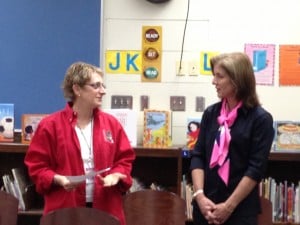
- Sheryl Weiss and Caroline Kennedy share their experiences with books and poetry with Horace Mann 4th Grade class
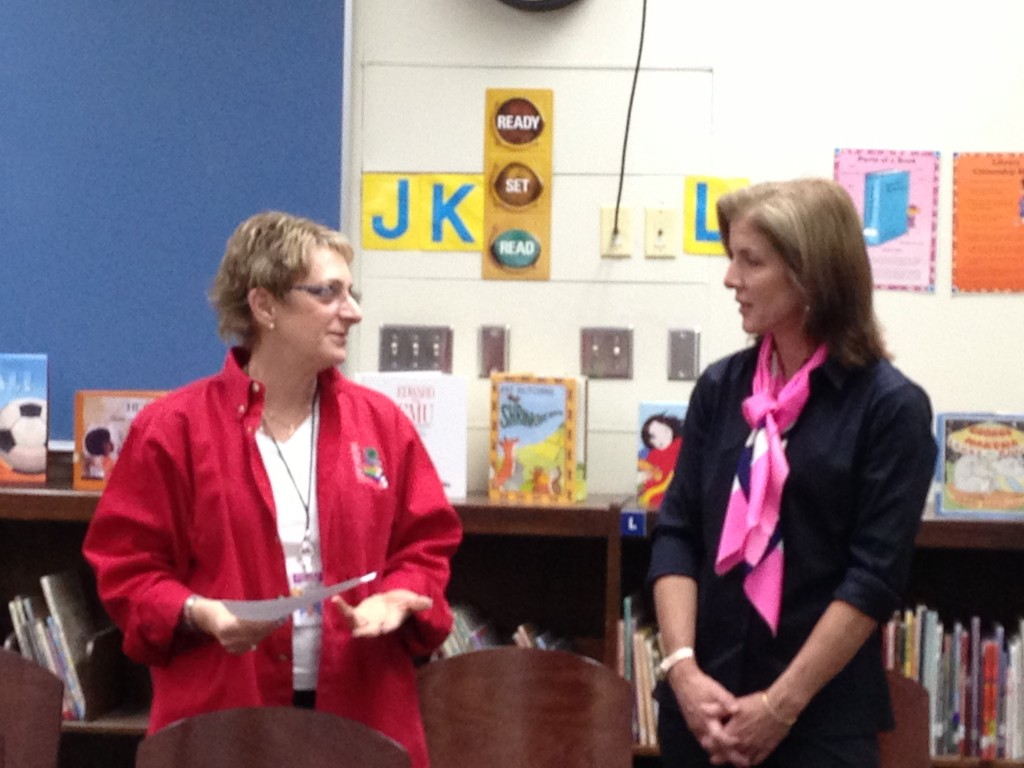
Caroline Kennedy and Sheryl Weiss also talked to the class about favorite books, why they like to read, what they can do to encourage other people to read, and why the library is a different from the classroom. One student shared how in the library she reads whatever she likes, while in the class they have to stick to specific class subjects. Caroline Kennedy agreed that the library is a place where you can follow whatever you are interested in, reading for fun.
So sadly, Beverly Hills USD, Sheryl's school district, has her position, and that of Diane Sikkenga, the one other K-8 Teacher Librarian in BHUSD, on the cut list. Tuesday's event was just one demonstration of the crucial role Sheryl plays as a teacher librarian in helping her students learn to appreciate literature and become information literate. I am counting on the district to find a way to rescind these cuts and retain these valuable teacher librarians for the sake of their students.
So sadly, Beverly Hills USD, Sheryl's school district, has her position, and that of Diane Sikkenga, the one other K-8 Teacher Librarian in BHUSD, on the cut list. Tuesday's event was just one demonstration of the crucial role Sheryl plays as a teacher librarian in helping her students learn to appreciate literature and become information literate. I am counting on the district to find a way to rescind these cuts and retain these valuable teacher librarians for the sake of their students.
Sunday, July 22, 2012
CSLA 2012 Conference - Join Us!
As current CSLA President Elect, my biggest responsibility is overseeing our 2012 Annual Conference, slated for San Jose November 16-19. I actually first started working on it about a year ago, when I sent out a survey to our members about their preferences for locations. It's now four months away, and we just passed a big milestone when we opening registration early this month. Please visit our conference wiki to get all the information about the schedule and how to register and book your room at the Marriott.
Also, please check out this short movie to learn about some of the highlights. I just learned this week about Powtoon this week. It has a lot of cool, fun features that makes creating animation easy, and I wanted to try it out. One of my favorite features is the hand that can be used to sweep items on and off the screen. This embed is the YouTube version. Powtoon makes exporting to YouTube very easy. I can definitely see using this new tool for virtual lessons or library information films on my library website and blog.
Also, please check out this short movie to learn about some of the highlights. I just learned this week about Powtoon this week. It has a lot of cool, fun features that makes creating animation easy, and I wanted to try it out. One of my favorite features is the hand that can be used to sweep items on and off the screen. This embed is the YouTube version. Powtoon makes exporting to YouTube very easy. I can definitely see using this new tool for virtual lessons or library information films on my library website and blog.
Sunday, May 6, 2012
Google Search Education Portal

As a Teacher Librarian, many of my class lessons focus on offering pathfinders and pointing students to the best quality sources available for their research projects. At the top of most of my pathfinders are any subscription databases (mostly those accessible to us through our county library system) that might help with their topics, since I want them to know about the best quality sources available. I am very well aware, though, that even when I am able to offer links to great databases for a given assignment, most of the students will prefer "Googling" it. I think we do a diservice to our students when we simply point to good sources and don't also teach them the best ways to ferret the information out of these sources using good search strategies and how to effectively search and evaluate information on the open web.
I was delighted this week to learn about Google's new Search Education Hub, which offers lesson plans, slides, and videos to help students and educators alike learn effective search and evaluation techniques, including:
- Picking the right search terms
- Understanding search results
- Narrowing a search to get the best results
- Searching for evidence for research tasks
- Evaluating credibility of sources
For each of these topics, there is a beginner, intermediate, and advanced lesson option. So far, I have checked out the beginning search terms lesson, the advanced evaluating credibility lesson, and several in between. I learned some techniques I didn't know in each of them, so I know they will provide my students and classroom teachers alike with new information and skills. I definitely plan to go through each of these for my own review and new information, and to find ways to share them with students and teachers.
Here's a video introduction:
Here's a video introduction:
Thanks so much to Tasha Bergson-Michelson, Google Search Educator, for leading the team developing these and for sharing them with me. Those of you attending the CSLA (California School Library Association) Annual Conference in November will have the great opportunity to hear Tasha's keynote presentation on Saturday, November 17 on "Curiosity, creativity, and critical thinking: Why school libraries matter more than ever." You can also plan to arrive early on November 16 and participate in the pre-conference tour of Google along with a special Google workshop. Do put these dates on your calendar now!
Saturday, March 31, 2012
Why I Present and You Should Too

The first time I did a presentation for a CSLA event, during a Southern Section Workshop, I have to admit that I was extremely nervous and I promised myself on my way there that I would never put myself through that stress again. Well, I broke that promise less than a week later when I submitted a proposal to speak at the next CSLA Annual Conference. Why? Well, here are just a few of the reasons why my very first presentation at a school library professional event got me hooked:
- I learn so much about my topic every time I prepare a presentation. Whatever I may know about a topic before I start planning my talk, I always develop further expertise as I do more research, look for additional resources to share, and ponder how I am going to organize what I say. If there is something you want to become an expert at, volunteer to do a presentation about it; you will grow into that expertise as you prepare.
- I learn so much during the presentation itself. I learn which delivery techniques work, which don’t so well, and what I can change the next time. I learn from the questions members of the audience ask that may make me think about the topic in a new way. Questions also give me the validation of realizing how much I really know about my topic that others want to hear about from me.
- I learn related new skills, such as how to better exploit the capabilities of presentation and graphics software. I first learned Prezi.com, which is now my favorite presentation application, because I set myself a challenge to use it for a presentation that was coming up.
- I meet new friends and my PLN (personal learning network) grows. There is nothing more gratifying than having people introduce themselves and tell me they enjoyed hearing my talk.
- And, yes, I definitely get an adrenal rush from the stress beforehand, a few moments in the spotlight during it, and the satisfaction afterwards of a job well done. And, yes, I bet you will too. :)
So, treat yourself to some fun, hard work, and a growing experience: prepare a proposal to present a concurrent session at the CSLA 2012 Conference in San Jose. Concurrent Session Chairs Ellie Goldstein-Erickson and Sandra Lane await your submissions! Proposals are due on April 14. Visit this link for information.
If you are reading this and have already had the great experience of presenting, please share a comment about why YOU choose to present.
(cross-posted to cslablog.blogspot.com)
Sunday, February 5, 2012
UC Davis Academic Literacy Summit
(If you happen to follow my Mira Costa Library blog, please excuse the cross-posting. I wanted to be sure to share this review of my experience at the UC Davis Academic Literacy Summit as widely as possible.)
I was very fortunate last Thursday to attend UC Davis’s fifth annual Academic Literacy Summit. My attendance was sponsored by Stacey Aldrich, California State Librarian, who funded participation by 10 statewide teacher librarians and 10 public librarians. The summit, with approximately 200 K-16 educators, explored the topic “What’s at the Core of Academic Literacy,” with special focus on the new Common Core Standards. A huge plus of the summit for me was the opportunity to share ideas with educators from multiple grade levels, ranging from elementary school through college.
The opening presentation of the day was a teaching demonstration by Jose Rivas, Physics and Engineering Teacher at Lennox Math, Science, and Technology Academy in Inglewood and a recipient of the Carlston Family Foundation 2011 Outstanding Teacher Award. Rivas was able to both teach us a physics lesson and articulate his techniques as he progressed. He showed us how he builds emotional connections with students to engage them and help them retain material through hands-on exploration, fun competition, self-assessments, and lively film clips. He emphasized how a short movie or song can help students retain an important concept. He spends minimal time doing direct instruction, since the students spend most of their time actively working on solving problems with other students. Our challenge was to use a collection of Styrofoam cups, paper clips, tape, wooden sticks, and rubber bands to create a catapult for a marble that would send the marble further than our other classmates’ examples. We all got into the spirit of the competition, although I am afraid my group’s product was not very successful!
I came away highly motivated to incorporate these techniques in the lessons I teach. I especially liked his effective use of film clips. An audience favorite was the film he made himself in which a picture of Isaac Newton was talking to us. He used a software product called Crazy Talk in order to animate the picture. CrazyTalk is definitely on my "have to get and use" list now! Another example he shared that I think I could implement right away was a tic-tac-toe game. Students receive a sheet of physics computation questions at different levels of difficulty. Once they choose a level with which to begin solving problems, they can find the correct answers on a tic-tac-toe board which they compete with a classmate to complete. I think this tic-tac-toe model could be applied to problems in any subject area, including my own information literacy lessons in the library.
One of the breakout sessions I attended was led by Bill Macauley, Director of the University Writing Center at the University of Nevada, Reno. The intended focus of the session was on how we can help students make the transition from high school writing to college writing. In fact, though, our discussion was much broader, since there were educators from middle school through college participating. We discussed how the Common Core Standards provide a fairly even balance between higher order and lower order skills, and how we can balance them in writing instruction and practice. Macauley shared several handouts on designing effective writing assignments which I can, in turn share with Mira Costa teachers, and we all contributed our own ideas in small group and whole group discussions. One idea that I contributed myself to help students develop both lower order and high level skills is to alternate between structured writing assignments and more free form, creative writing such as blog postings. We also talked about how the teacher librarian can help the students focus on the structure and citation components of writing, while the subject area teacher focuses on the higher order analysis components. Another idea we discussed was the value of using Google Docs for writing assignments, allowing teachers to share comments with students online. One participant suggested taking advantage of the revision history feature and requiring students to articulate the kind of changes they make at each revision.
I attended a second breakout session on “You Can Have it All: Academic Literacy, Critical Thinking, and Student Engagement through the Common Core” led by Nicole Kukrai, Secondary Teacher on Special Assignment, San Juan Unified School District and Area 3 Writing Project. Like Rivas, Kukrai led us in a model lesson, and, at the same time, articulated the techniques or routines she uses to teach students and build a classroom culture of learning. The lesson in this case was reading and analyzing a short essay, We all came away with a number of routines for multiple readings of a text and student conversation promoting academic literacy in the classroom. Kukrai’s routines included “turn and talk” in which students pair up to discuss what they read, small group conversation, whole group sharing, and charting the discussion points. We all read the essay several different times, focusing on different types of questions for each reading. While we worked in pairs and small groups, Kukrai had time to move from group to group, assess our performance, and give help as needed. These routines are definitely good ideas I would like to use as models for my own teaching.
I came away from the summit with lots of good ideas for myself, many I can share with other Mira Costa staff, and a much better understanding of the new Common Core Standards and how I can help implement them. I am very grateful to have been able to attend this outstanding professional development day. I was also gratified that so many of the classroom teachers and other attendees seemed so pleased to have a large group of librarians in their midst and contributing to the discussions.
Subscribe to:
Posts (Atom)